Side-by-side or overlay PDF diff driven by one engine that reads each file into a structured model — text, vector geometry, images, form fields, annotations — and compares the models. Moves show as moves, edits show only where they happened, and any PDF type works without picking a mode.
Open a STEP / STP part and it measures itself — volume, thinnest wall, draft and undercut checks on load, plus hole detection with a BOM. Measure, section, export STL. Rust + WASM B-rep kernel, runs in your browser.
A fermentation atlas where every number says where it came from
The Fermentation Atlas shows how fermented foods and drinks are made, step by step, with each time, temperature, salt and pH value labelled by its source.
A recipe for sauerkraut says “2% salt”. A recipe for lahpet, the fermented tea of Myanmar, says “leave it in the pit for a few months”. Both numbers might be right. A careful reader still can’t tell where either came from: a study, a legal specification, one cook’s habit, or a guess copied from another site.
The Fermentation Atlas is our answer to that. At launch it covers 2,854 fermented foods and drinks, and 1,158 of them have their own page. More get pages as their research is finished. Each page shows how the ferment is made, one step at a time. Every time, temperature, salt and pH value on it carries a label that says what kind of source stands behind it.
What a recipe leaves out
Three things are hard to see in an ordinary recipe, however carefully you read it.
1. Where the number came from
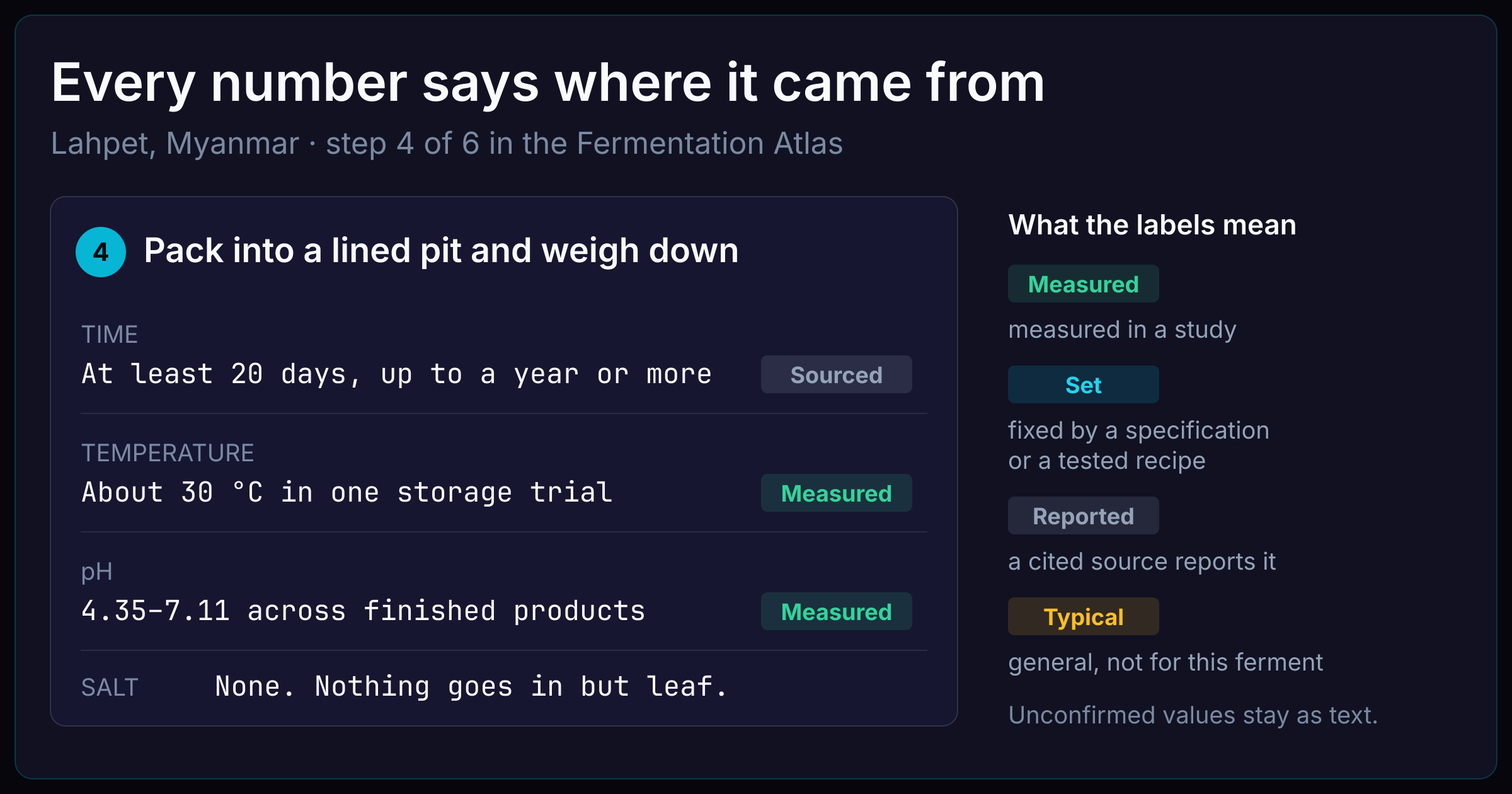
The sauerkraut “2%” is a good example. In the atlas it reads “2.0–2.25 % of the cabbage weight”, labelled Set. That label means it comes from a tested recipe or a specification. Here the source is a USDA study that names this range as the optimum.
Other numbers are softer, and the label says so. Each value gets one of these labels:
Measured: measured in a study.
Set: fixed by a specification or a tested recipe.
Reported: a cited source reports it.
Typical: a general value, not sourced for this ferment.
A value nobody has confirmed is shown as text, not as a number, so you can see what is still missing.
2. Which numbers nobody fixed
People often assume a famous ferment has exact rules. Sometimes it does. Parmigiano Reggiano’s specification sets at least 12 months of ageing. It does not set how long the wheels float in brine. It says only “after a few days”. Three studies in the atlas give 18–20 days, 20–24 days and 23 days.
A recipe that says “brine for 21 days” makes one maker’s choice look like a rule. The atlas shows the rule and the studies side by side, each with its own label.
3. What is happening inside the jar
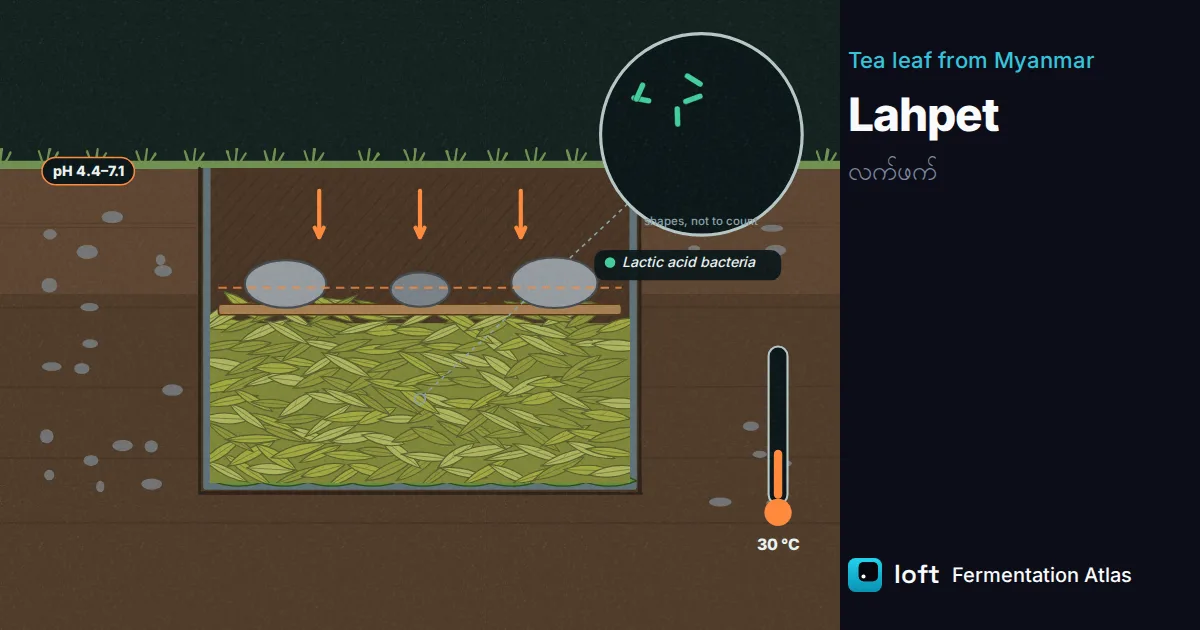
A step like “pack and weigh down” says what your hands do. It doesn’t say what changes. Each atlas step is drawn as a scene: the vessel, what is in it, the one thing that changes during that step, and the microbes doing the work.
Lahpet's pit step as the atlas draws it. Nothing is added to the leaves. Lactic acid bacteria from the leaf and the pit sour them.
One value, as the atlas stores it
Every value is stored the way its source wrote it, with the parsed range and the source beside it. Here is the pH of finished lahpet:
That range matters. A pH above 4.6 is above the limit food-safety agencies use for botulism control. So the lahpet page says plainly that seasoned lahpet should be kept cold. A recipe that gives no pH can’t tell you that.
How it is checked
AI research assistants search and read published sources in many languages. They record each step, each number with its unit, and where it came from. Those sources include protected-origin specifications, national standards, food-safety agencies, peer-reviewed studies and theses. Every entry is then checked:
Every DOI and link is looked up to confirm it exists and matches the citation.
A validator checks each value’s units and ranges against the text recorded with it.
Samples of values are checked by hand against their sources.
Safety limits, such as starting pH and salt for fish, need a food-safety authority as the source.
The full method is on the How this atlas is made page. The atlas describes how ferments are made. It is not a food-safety guide. For home preserving, follow a tested recipe from a food-safety authority.
Where to start
Search for a ferment you know, such as sauerkraut, lahpet or feta. You can also browse by kind or by region. Entries that don’t yet have a page are listed in full on their kind and region pages. They get a page of their own once their sources give enough detail.
If you find a value that doesn’t match its source, tell us through the contact page. Name the ferment and the value, and we’ll check it against the source and fix it.