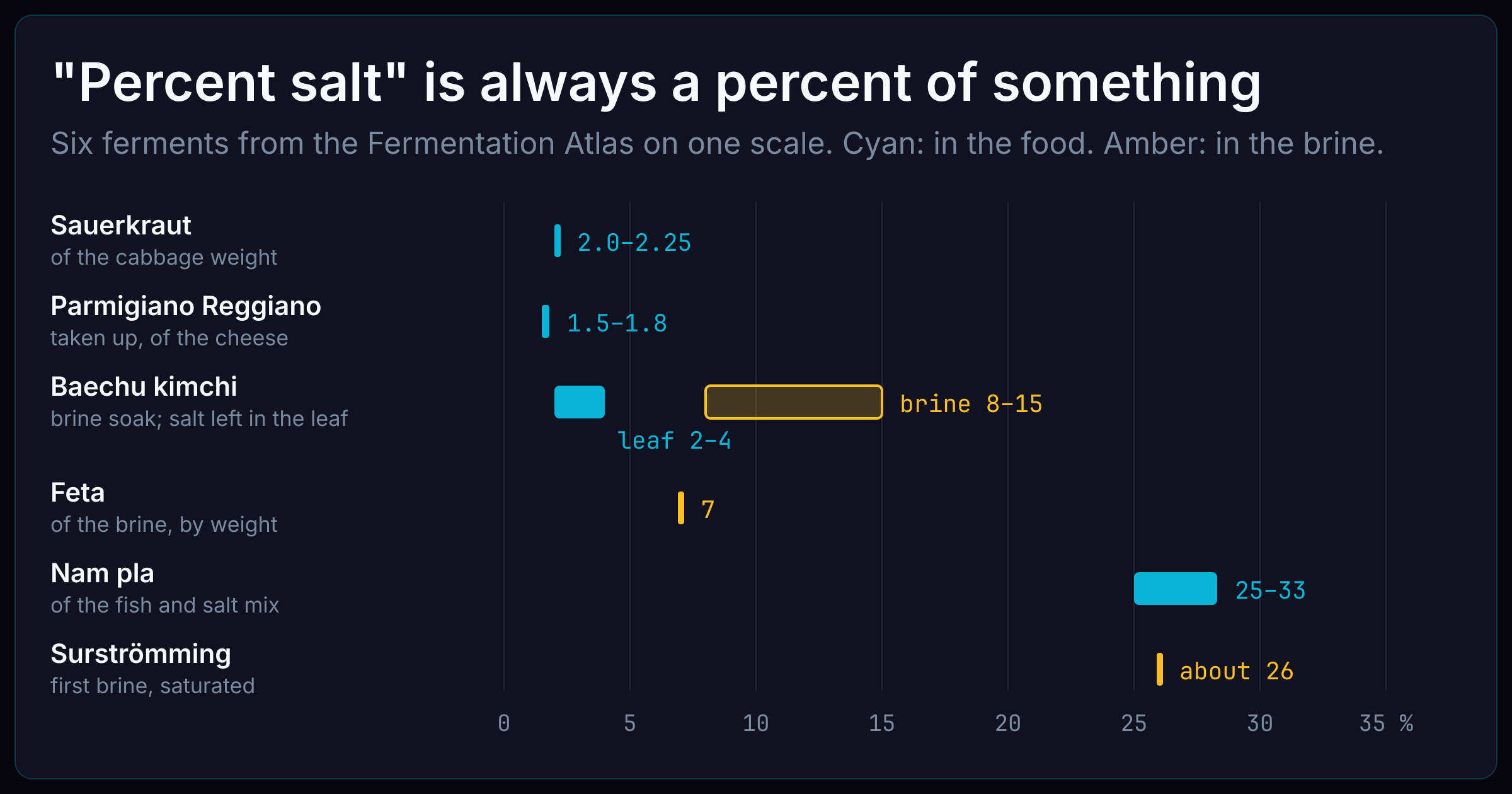
“Use 2% salt” sounds exact. It isn’t, until you know what the 2% is measured against. It could be the weight of the vegetable, the weight of the brine, the weight of the water before the salt goes in, or the finished food. Each choice gives a different amount of salt in your jar.
A careful cook reads the number and the method. The base, the thing the percent is of, is often missing from both. The Fermentation Atlas records it beside every salt value, as its source states it. Here are five ways the same-looking number differs, with values from six ferments.
1. Percent of the vegetable, or percent of the brine
Sauerkraut is dry-salted. The salt goes straight onto the shredded cabbage at 2.0–2.25% of the cabbage weight. That is the optimum named in a USDA study, and the atlas labels it Set. All of that salt stays with the cabbage.
Baechu kimchi works differently. The whole cabbage first soaks in a brine of 8–15% salt for a few hours. Then it is rinsed and drained. FAO’s account says the leaf ends at 2.0–4.0% salt. A Korean study measured 2.4–3.0% in the kimchi solids from start to finish.
So “8%” in a kimchi recipe is the brine, not the cabbage. If you read it as 8% of the cabbage weight and dry-salted with it, every gram would stay in the leaf. That’s two to four times the salt the studies measured.
2. A ratio is not a percent
Fish sauce recipes usually give a ratio. For nam pla, the Thai fish sauce, the atlas records 1 part salt to 2 or 3 parts fish by weight.
It is easy to read 1:2 as 50% salt. It isn’t. One part salt in three parts of mix is 33%. One part in four is 25%. So the atlas gives the range as “about 25–33% of the fish and salt mix”. The source also notes that Thai makers range from 5:1 to 1:1.
Colatura di alici, the anchovy sauce of the Amalfi coast, has the same trap in its rules. The protected-origin specification sets anchovy to salt at no less than 2:1 by weight. That means salt is at most a third of the mix.
3. What goes in is not what comes out
Colatura’s specification also sets a value for the finished sauce: at least 20 grams of salt per 100 grams of product. That’s a second number, measured against a second base. The one study in the atlas measured about 25% in finished colatura.
Cheese shows the same gap from the other side. Parmigiano Reggiano wheels float in brine for about three weeks. They take up only 15–18 g of salt per kg of cheese, which is 1.5–1.8%. The brine’s strength and the cheese’s salt are two different numbers. A recipe that gives one doesn’t give you the other.
4. Grams per litre of water is not a percent
Surströmming, the fermented Baltic herring, starts in a saturated brine. The Swedish Food Agency’s process description gives it as 359 g of salt in 1 litre of water, or 25 °Baumé.
Read quickly, “359 g per litre” looks like 36%. But the salt is added to a litre of water, so the brine weighs 1,359 g. The salt is 359 ÷ 1,359, about 26% of the brine. Degrees Baumé, the old hydrometer scale the agency also uses, are close to percent salt by weight in this range. The atlas keeps the source’s own words in the value’s text, so you can check the conversion yourself:
salt_pct:
  text: Saturated brine, 359 g salt in 1 litre of water (25 °Baumé), about 26 % salt; 2/3 fish to
    1/3 brine
  ev: set
  unit: "%"
  basis: of the brine
  min: 26
  max: 26
  src: [lv-process]
5. Some numbers are rules, and some are one study
Feta’s protected-origin rules set its brine at 7% NaCl by weight. That’s a legal number, so the atlas labels it Set. The kimchi leaf’s 2.4–3.0% comes from one study and is labelled Measured. Nam pla’s ratio is labelled Reported: a cited source reports it, but no rule fixes it.
The label tells you how much weight to give a number. The base tells you what the number means. A salt value is only useful with both.
Where to look
Every curated ferment page in the atlas shows its salt values with their base and label. Start with sauerkraut, baechu kimchi, nam pla or surströmming.
The atlas describes how ferments are made. It is not a food-safety guide. For home preserving, follow a tested recipe from a food-safety authority.
Open the Fermentation Atlas