Side-by-side or overlay PDF diff driven by one engine that reads each file into a structured model — text, vector geometry, images, form fields, annotations — and compares the models. Moves show as moves, edits show only where they happened, and any PDF type works without picking a mode.
Open a STEP / STP part and it measures itself — volume, thinnest wall, draft and undercut checks on load, plus hole detection with a BOM. Measure, section, export STL. Rust + WASM B-rep kernel, runs in your browser.
Black garlic (boundary, not a microbial fermentation)흑마늘
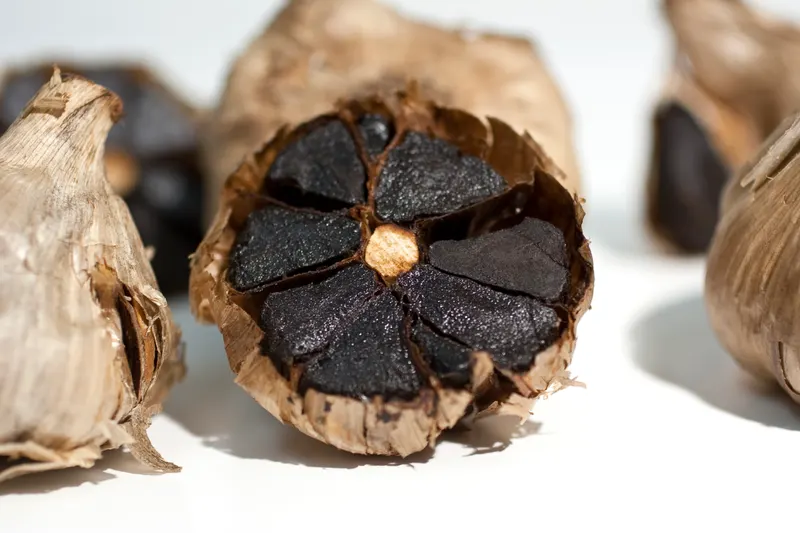
Black garlic is whole garlic held warm and humid for weeks until the cloves turn black, soft and sweet. It is a boundary entry, not a microbial ferment. The change is mostly chemical, driven by heat and humidity (the Maillard reaction, caramelisation and phenol oxidation), and nothing is added.
Amounts from a sourceIndustrial and home process with no fixed batch size. Garlic is the only ingredient. In one study 60 kg of dried bulbs were split into 5 kg trays (Shin 2024).
Sulmona garlic bulbs1 kg per machine
Fresh whole bulbs; nothing else goes in. One of the two varieties in the Italian domestic-machine study.[addazii2025]
Voghiera garlic bulbs1 kg per machine
The second variety in the same study, run in its own machine.[addazii2025]
Starter
none
Total time across the recorded steps: 25 days – 3.3 months
Start
Drag the bar or press Play
What changes:Whole garlic bulbs dry in warm air before ageing
Step 1 of 4
Dry the harvested bulbs
Time
10 days
Reported
Temperature
40 °C
Reported
Salt
None given
Acidity
Not documented
Output: dried whole bulbs.
Flavour
Not documented
Texture
Not documented
Colour
Not documented
Microbes at work in this step
Not documented for this step.
Method
Measured measured in a studySet fixed by a specification or tested recipeReported one source reports itTypical a general value, not sourced for this fermentUnconfirmed not yet checked against a source
At a glance
Black garlic is whole garlic held warm and humid for weeks until the cloves turn black, soft and sweet. It is a boundary entry, not a microbial ferment. The change is mostly chemical, driven by heat and humidity (the Maillard reaction, caramelisation and phenol oxidation), and nothing is added. Made in 4 steps over 25 days – 3.3 months. The longest step, age the bulbs warm and humid, takes 15 days – 3 months (Vecchi V 2025) and runs at 60–90 °C (Vecchi V 2025). No fermenter; the change is driven by heat and humidity, not by microbes does most of the fermenting.
Unlike real ferments, no microbe does the work. Heat and humidity alone turn garlic sugars and amino acids brown, much as in roasting, only slower. Unlike pickled garlic, nothing is added.
Italian domestic machine processWhole bulbs of two Italian garlic varieties, 1 kg per machine, held at 75 °C and 80 % relative humidity for 12 days (Addazii 2025).
Safety
Kept as a "looks like a ferment but is not" card. The finished cloves are acidic (pH about 4.2–4.4 in one study) and low in water. In an Italian domestic-machine study (75 °C, 80 % relative humidity, 12 days), yeasts and moulds fell below the detection limit by day 6 and mesophilic bacteria by day 12, and pH fell from about 5.9 to 3.7 and water activity from about 0.98 to 0.63–0.71 (Addazii 2025).
Its origin is unclear; a 2025 review says historical evidence points to Asian countries eating it since ancient times. A 2025 study of domestic production in Italy describes the origin as debated between Japanese, Korean and Chinese sources, and the method as largely spread in Asian cuisines but seldom made in Europe.