Side-by-side or overlay PDF diff driven by one engine that reads each file into a structured model — text, vector geometry, images, form fields, annotations — and compares the models. Moves show as moves, edits show only where they happened, and any PDF type works without picking a mode.
Open a STEP / STP part and it measures itself — volume, thinnest wall, draft and undercut checks on load, plus hole detection with a BOM. Measure, section, export STL. Rust + WASM B-rep kernel, runs in your browser.
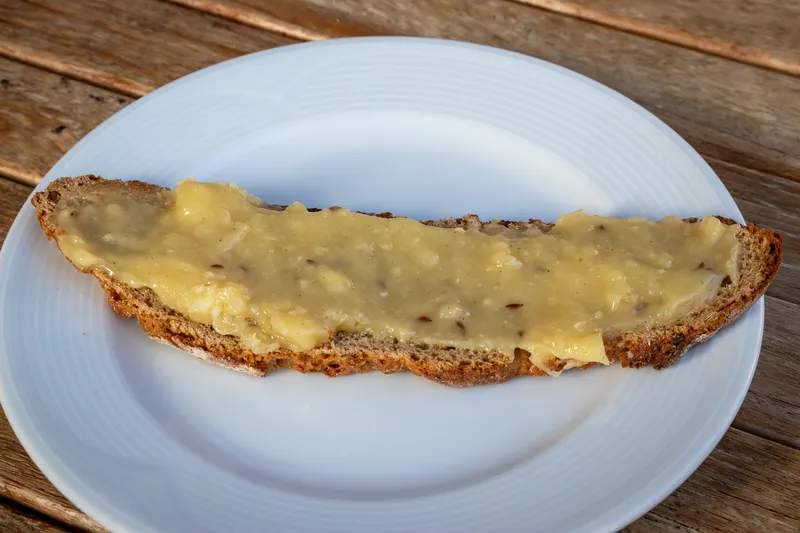
Dry low-fat quark is crumbled and left covered at room temperature for two to three days until it turns glassy and smells sharp. It is then salted, spiced with caraway and melted in hot clarified butter while it is stirred hard ('linden'), until it flows as one mass. Poured into a bowl and chilled, it sets to a spreadable or sliceable cheese.
Total time across the recorded steps: 2 days – 3 days
Start
Drag the bar or press Play
What changes:The crumbled quark ripens for two to three days until it turns glassy and smells sharp
Step 1 of 4
Crumble and ripen the quark
Time
2–3 days
Reported
Temperature
Not documented
Salt
None given
Acidity
Not documented
Which microbes the steps name, step by step
Lactic acid bacteria
S. thermophilus
L. delbrueckii
Flavour
sharp, pungent smell when ready
Texture
crumbly at first, then glassy and slippery
Colour
Not documented
Microbes at work in this step
Not documented for this step.
Method
Measured measured in a studySet fixed by a specification or tested recipeReported one source reports itTypical a general value, not sourced for this fermentUnconfirmed not yet checked against a source
At a glance
Dry low-fat quark is crumbled and left covered at room temperature for two to three days until it turns glassy and smells sharp. It is then salted, spiced with caraway and melted in hot clarified butter while it is stirred hard ('linden'), until it flows as one mass. Poured into a bowl and chilled, it sets to a spreadable or sliceable cheese. Made in 4 steps over 2 days – 3 days. The longest step, crumble and ripen the quark, takes 2–3 days (Bundesministerium für Land- und Forstwirtscha…). Salt is 1 % (Bundesministerium für Land- und Forstwirtscha…). Lactic acid bacteria does most of the fermenting.
The ripened quark is melted in hot butter with caraway and stirred until it flows, instead of being shaped and ripened as small cheeses; the Codex groups it with the spreadable Kochkäse.
Codex type
A Kochkäse made from ripened quark; at least 51 % of its dry matter must come from quark dry matter
Dry matter
Spreadable Kochkäse needs at least 21 % dry matter at the lean level (up to 15 % fat in dry matter) and 30 % at the half-fat level
Appearance
Pale yellow to greenish outside; creamy and spreadable to firm and sliceable, depending on how it is made
For a related German-origin cooked cheese, Brazilian Kochkäse, one study of three ripening temperatures (15, 25 and 35 °C) found 15 °C gave the best ratio of lactic acid bacteria to undesirable groups, and another reports that final cooking at 90 °C was crucial for reducing the microbial load. The 2020 study notes that raw milk presents some safety concerns. These are findings on that cheese, not on Glundner.