Side-by-side or overlay PDF diff driven by one engine that reads each file into a structured model — text, vector geometry, images, form fields, annotations — and compares the models. Moves show as moves, edits show only where they happened, and any PDF type works without picking a mode.
Open a STEP / STP part and it measures itself — volume, thinnest wall, draft and undercut checks on load, plus hole detection with a BOM. Measure, section, export STL. Rust + WASM B-rep kernel, runs in your browser.
Skimmed milk is left half a day to a day to sour, then heated until it curdles; in an alternative method it is renneted at 30 °C. The curd is squeezed in a cloth and kneaded three times in ever hotter whey, up to 73–75 °C, salted at 1.5 g per 100 g and packed into a hollowed pine log (koloti). It ripens at least 3 months below 10 °C. Steps follow the Çayeli Koloti registration.
skimmed milk left to sour in the cauldron for half a day to a day (registered method); rennet in the alternative method
Total time across the recorded steps: 3 months
Start
Drag the bar or press Play
What changes:The milk is strained and the cream is separated off
Step 1 of 7
Strain and skim the milk
Time
Not documented
Temperature
Not documented
Salt
None given
Acidity
Not documented
Which microbes the steps name, step by step
Lactic acid bacteria
The milk is strained and its cream taken off with a separator.
Flavour
Not documented
Texture
Not documented
Colour
Not documented
Microbes at work in this step
Not documented for this step.
Method
Measured measured in a studySet fixed by a specification or tested recipeReported one source reports itTypical a general value, not sourced for this fermentUnconfirmed not yet checked against a source
At a glance
Skimmed milk is left half a day to a day to sour, then heated until it curdles; in an alternative method it is renneted at 30 °C. The curd is squeezed in a cloth and kneaded three times in ever hotter whey, up to 73–75 °C, salted at 1.5 g per 100 g and packed into a hollowed pine log (koloti). It ripens at least 3 months below 10 °C. Steps follow the Çayeli Koloti registration. Made in 7 steps over 3 months. The longest step, pack into the koloti and ripen, takes at least 3 months (TÜRKPATENT (Turkish Patent and Trademark Offi…) and runs at up to 10 °C (TÜRKPATENT (Turkish Patent and Trademark Offi…). Salt is 1.5 % (TÜRKPATENT (Turkish Patent and Trademark Offi…). Lactic acid bacteria does most of the fermenting.
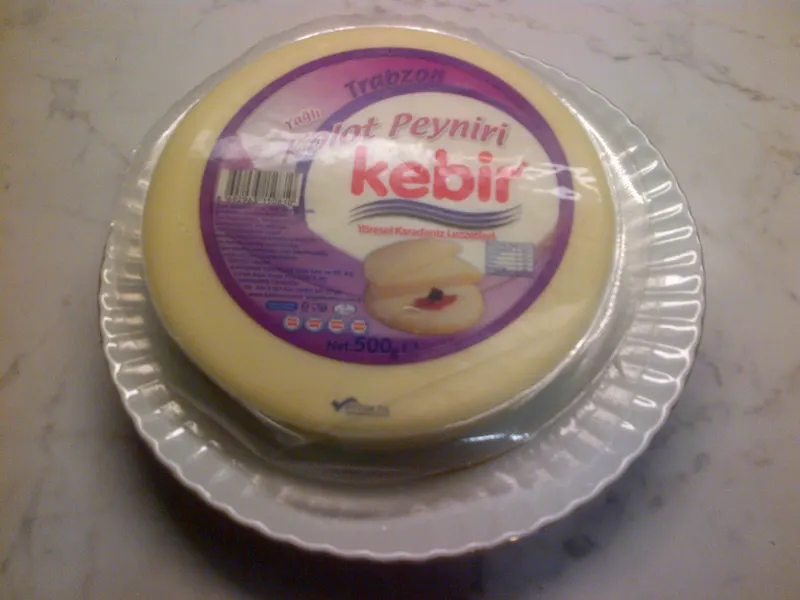
A low-fat cheese from soured skimmed milk whose curd is kneaded three times in hotter and hotter whey and then ripened in a hollowed pine log. The log, the koloti, gives the cheese its name.
Shape
Off-white, broad and thin
Composition (Çayeli koloti)
Fat 5–12% (a low-fat cheese), dry matter 45–52%, protein 27–40%, salt 1.4–5.2%
Use
Wikipedia says it is used to make muhlama
Eaten fresh or ripened
The Çayeli registration has the cheese ripen at least 3 months in the koloti, while a survey of Trabzon and Rize golot reports that it is mostly eaten fresh
Salt in surveyed golot
Salt averaged 2.95 ± 0.93 % in 30 samples from Trabzon and Rize
The Çayeli registration scalds the curd in whey at 73–75 °C and ripens it at least 3 months below 10 °C. A survey of Trabzon golot found coliforms in about a third of samples but no E. coli or Salmonella, while a separate survey of 30 Trabzon and Rize samples found E. coli in three and Staphylococcus aureus in two. The sources also differ on the heat step. Tunçtürk and Özdemir report the curd cooked at 85–90 °C, and Wikipedia describes boiling cut curd in 80–90 °C brine.
Hazards the sources name: Coliform bacteria (found in 36.67% of samples; E. coli and Salmonella found in none); E. coli (found in 3 of 30 samples) and Staphylococcus aureus (found in 2 of 30) in a separate survey of Trabzon and Rize golot; the two surveys disagree on E. coli.
The registration dates Çayeli koloti to about 200 years ago, made from the milk of animals grazing the high villages and pastures of Çayeli, above all the Senoz valley. It was registered as a designation of origin on 24 August 2022 on an application filed 20 November 2020. A 2005 survey describes golot as made mostly on family farms in Trabzon and Rize, usually by acid coagulation.