Side-by-side or overlay PDF diff driven by one engine that reads each file into a structured model — text, vector geometry, images, form fields, annotations — and compares the models. Moves show as moves, edits show only where they happened, and any PDF type works without picking a mode.
Open a STEP / STP part and it measures itself — volume, thinnest wall, draft and undercut checks on load, plus hole detection with a BOM. Measure, section, export STL. Rust + WASM B-rep kernel, runs in your browser.
Fish and seafood from Korea, west coast and Gyeonggi
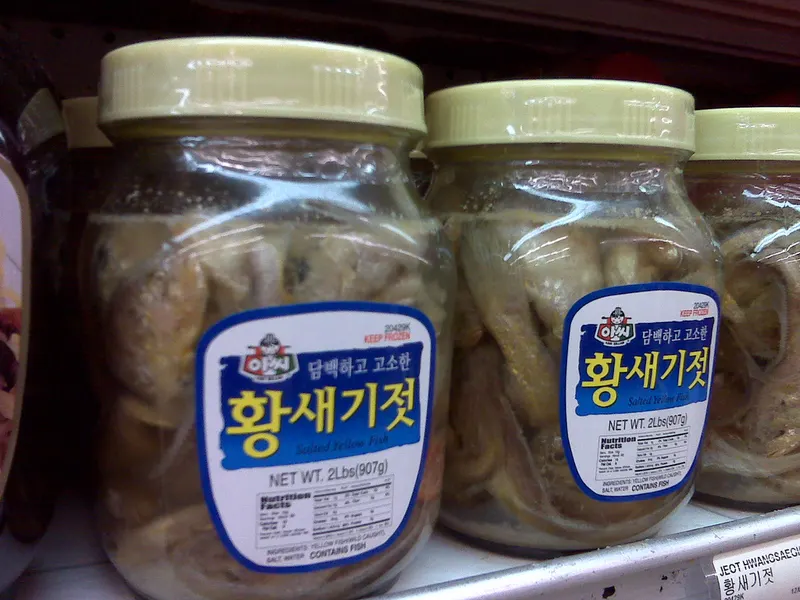
Jogijeot (salted yellow croaker)조기젓
Jogijeot is whole yellow croaker salted as jeot. The fish are washed in salt water, their mouths and gills stuffed with coarse salt, layered with salt in a crock, covered with bamboo slats and boiled, cooled brine, and sealed. It ripens for three months or more; the flesh is dressed as a side dish and the liquid seasons kimchi.
What changes:The whole croaker are washed in salt water
Step 1 of 6
Wash in salt water
Time
Not documented
Temperature
Not documented
Salt
None given
Acidity
Not documented
The croaker are washed in salt water and drained.
Flavour
Not documented
Texture
Not documented
Colour
Not documented
Microbes at work in this step
Not documented for this step.
Method
Measured measured in a studySet fixed by a specification or tested recipeReported one source reports itTypical a general value, not sourced for this fermentUnconfirmed not yet checked against a source
At a glance
Jogijeot is whole yellow croaker salted as jeot. The fish are washed in salt water, their mouths and gills stuffed with coarse salt, layered with salt in a crock, covered with bamboo slats and boiled, cooled brine, and sealed. It ripens for three months or more; the flesh is dressed as a side dish and the liquid seasons kimchi. Made in 6 steps over 3 months. The longest step, ripen, takes at least 3 months (Choi Y.H. (최영희)). Salt is 20 % (Cha Y.J. and Lee E.H. 1985).
The croaker stay whole, with salt stuffed into the gills, and are covered with boiled, cooled brine under bamboo slats; most jeotgal is simply mixed with dry salt. Gyeonggi kimchi uses its liquid for a milder taste than anchovy jeot.
Season
Salted from early May to mid-June; eaten from October
Use
Gyeonggi households use much jogijeot in kimjang kimchi; it is milder and less fishy than anchovy jeot
Jogijeot muchimThe ripe flesh torn and dressed with spring onion, garlic, chilli powder and vinegar.
Safety
A 1985 study took about 20 % salt as the conventional level for jeotgal, and used it for its jogijeot controls. The fish are covered with boiled, cooled brine and the crock is sealed. Salt is packed into the gills, and the sources we read do not say the fish are gutted. FDA says Clostridium botulinum spores have been found in fish gills and viscera. It advises gutting any fish preserved by salting or fermenting, because without gutting toxin can form even with strict temperature control. Its exception covers only small fish under 5 inches. FDA separately lists 20 % water-phase salt or more as a control for shelf-stable salted products; the 1985 study does not give its figure as water-phase salt.
The Haedong yeoksa lists croaker among fish eaten before Unified Silla. The 19th-century Gyuhap chongseo soaks jogijeot, junchi and banji jeot overnight and uses croaker jeot liquid for seokbakji kimchi, an early record of jogijeot in kimchi.