Side-by-side or overlay PDF diff driven by one engine that reads each file into a structured model — text, vector geometry, images, form fields, annotations — and compares the models. Moves show as moves, edits show only where they happened, and any PDF type works without picking a mode.
Open a STEP / STP part and it measures itself — volume, thinnest wall, draft and undercut checks on load, plus hole detection with a BOM. Measure, section, export STL. Rust + WASM B-rep kernel, runs in your browser.
Pepperoni is an American variety of spicy salami made from pork, or pork and beef, seasoned with paprika. In an Irish pilot-plant study a lactic starter culture soured the stuffed batter in about 8 hours at 37 °C in humid air, and the sausages were then dried for 7–9 days.
Amounts from a sourceA commercial pepperoni formulation used as the model in an Irish pilot-plant study (Crowley et al. 2026), as shares of the batter.
Total time across the recorded steps: 7.3 days – 9.3 days
Start
Drag the bar or press Play
What changes:Pork and beef fat are minced fine
Step 1 of 6
Mince the meat and fat
Time
Not documented
Temperature
Not documented
Salt
None given
Acidity
Not documented
Flavour
Not documented
Texture
Not documented
Colour
Not documented
Microbes at work in this step
Not documented for this step.
Method
Measured measured in a studySet fixed by a specification or tested recipeReported one source reports itTypical a general value, not sourced for this fermentUnconfirmed not yet checked against a source
At a glance
Pepperoni is an American variety of spicy salami made from pork, or pork and beef, seasoned with paprika. In an Irish pilot-plant study a lactic starter culture soured the stuffed batter in about 8 hours at 37 °C in humid air, and the sausages were then dried for 7–9 days. Made in 6 steps over 7.3 days – 9.3 days. The longest step, dry, takes 7–9 days (Crowley C.H 2026) and runs at 15 °C (Crowley C.H 2026). Salt is 2.5 % (Crowley C.H 2026).
Pepperoni is a fast, starter-driven ferment of a fine batter. In the pilot-plant study it soured in about 8 hours at 37 °C and was dried in 7–9 days at 15 °C.
Turkey pepperoniTurkey is also used as a substitute, and poultry in pepperoni must be labelled as such in the United States (Wikipedia).
Safety
In a challenge study with E. coli O157:H7 added to the batter, a standard pepperoni process (2.5 % salt, 100 ppm nitrite, pH 4.8) cut it by only about 0.41 log units in fermentation and 0.43 in drying (7 days), short of the 5-log reduction the US Food Safety and Inspection Service recommends. Higher salt and nitrite and a lower pH gave bigger reductions, but every formulation stayed below the 5-log target. These are factory and pilot-plant figures, not a tested home method, and fermenting and drying cannot be relied on to kill this organism in raw meat. The US CDC says the same of curing and drying for Trichinella worms, and undercooked pork is among the meats it names. The sodium nitrite here is pure nitrite, 0.015 % being 150 mg per kg of batter. Weigh it exactly and never by eye, because the CDC warns that nitrite poisoning can be fatal.
Hazards the sources name: Escherichia coli O157:H7, added to the batter in a challenge study, survived fermentation and drying of a standard formulation, with far less than the 5-log reduction FSIS recommends.
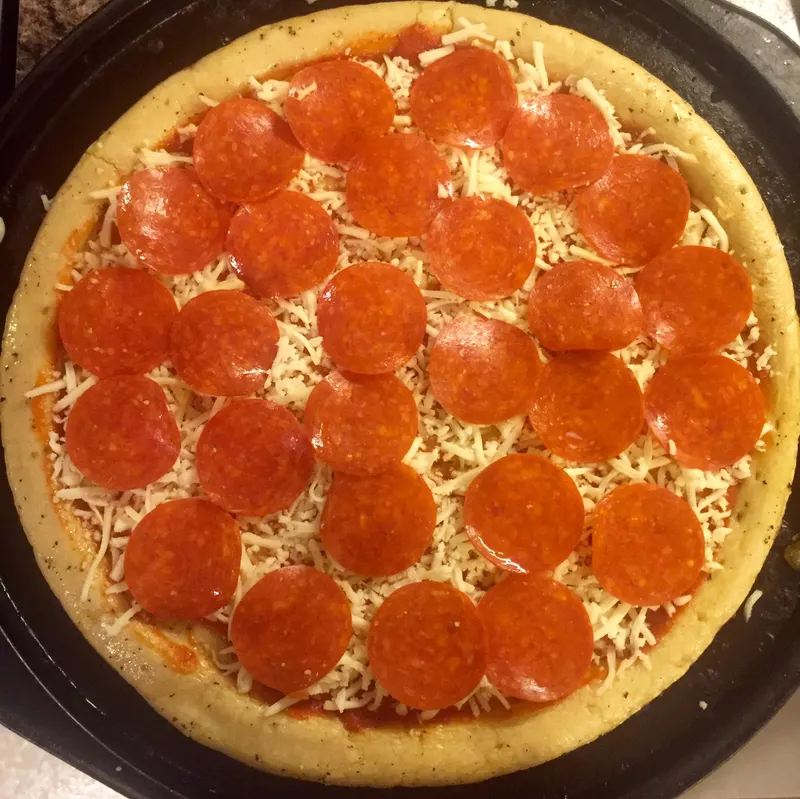
Wikipedia dates the first use of the word pepperoni for a sausage to 1916 at the latest, from an Alaskan newspaper, and says a 1919 source mentions it as available in New York City. It says the sausage is an American variety of salami and that sliced pepperoni became one of the most popular pizza toppings in American pizzerias.