Side-by-side or overlay PDF diff driven by one engine that reads each file into a structured model — text, vector geometry, images, form fields, annotations — and compares the models. Moves show as moves, edits show only where they happened, and any PDF type works without picking a mode.
Open a STEP / STP part and it measures itself — volume, thinnest wall, draft and undercut checks on load, plus hole detection with a BOM. Measure, section, export STL. Rust + WASM B-rep kernel, runs in your browser.
Vegetables from Germany, Central and Eastern Europe
Sauerkraut juice (Sauerkrautsaft)Sauerkrautsaft
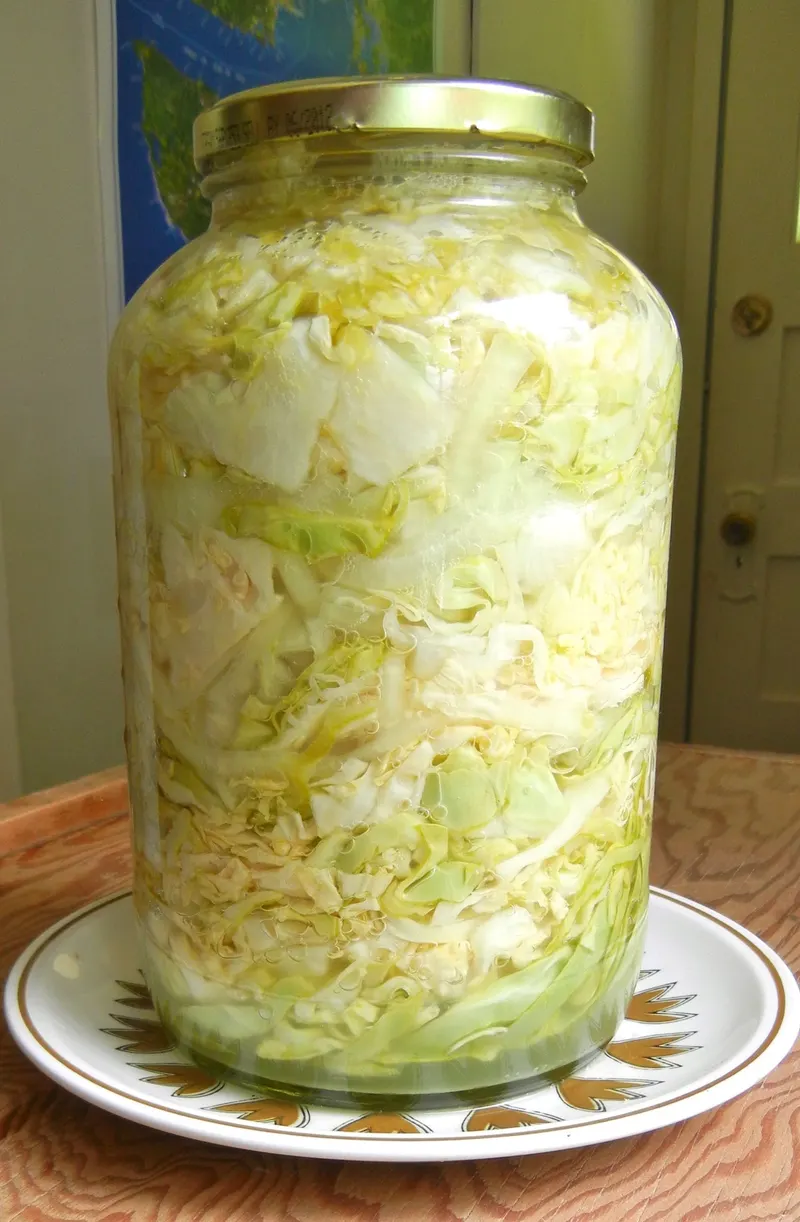
Sauerkraut juice is the cell juice that runs out of shredded, salted cabbage while it ferments into sauerkraut. In one Latvian maker's process cabbage with 1.7 % salt is pressed and fermented for 14 days, and the juice, about 30 % of the cabbage weight, is drained off at packing at about pH 3.7. Under German food guidelines a lactic-fermented vegetable juice may not be soured with vinegar or added acids.
Amounts from a sourceOne Latvian maker's sauerkraut recipe, as percentages of the cabbage, from Jansone et al. 2022; the juice is the liquid this batch releases.
What changes:Shredded cabbage is mixed with 1.7 % salt, grated carrot and caraway
Step 1 of 5
Shred the cabbage and mix with salt, carrot and caraway
Time
Not documented
Temperature
Not documented
Salt
1.7 %
Reported
Acidity
Not documented
Which microbes the steps name, step by step
Lactic acid bacteria
Flavour
Not documented
Texture
Not documented
Colour
Not documented
Microbes at work in this step
Not documented for this step.
Method
Measured measured in a studySet fixed by a specification or tested recipeReported one source reports itTypical a general value, not sourced for this fermentUnconfirmed not yet checked against a source
At a glance
Sauerkraut juice is the cell juice that runs out of shredded, salted cabbage while it ferments into sauerkraut. In one Latvian maker's process cabbage with 1.7 % salt is pressed and fermented for 14 days, and the juice, about 30 % of the cabbage weight, is drained off at packing at about pH 3.7. Under German food guidelines a lactic-fermented vegetable juice may not be soured with vinegar or added acids. Made in 5 steps over 14 days. The longest step, press and ferment into sauerkraut, takes 14 days (Jansone L 2022). Salt is 1.7 % (Jansone L 2022).
Unlike sauerkraut, the juice is the liquid, not the cabbage, and much of it is a by-product of packing. Under German guidelines it is a lactic-fermented vegetable juice that may be kept only by physical means and may not be soured with vinegar or added acids [leitsaetze].
Russian kapustny rassolThe brine of kvashenaya kapusta. The interstate standard GOST 34220-2017 for salted and fermented vegetables sets 1.2–2.0 % chlorides and 0.7–1.5 % titratable acid (as lactic acid) in the sauerkraut brine [gost34220].
Spray-dried sauerkraut juice powderJuice dried with a starch or maltodextrin carrier; the lab powder held about 12 % NaCl [jansone2022].
Safety
In a 2025 Polish survey of commercial sauerkraut, putrescine and cadaverine were the leading biogenic amines, and the amine index of 4 of 14 sauerkrauts passed the estimated upper toxicity limit [choinska2025]. That study tested the cabbage, not its juice. The juice is a by-product with a short shelf life [jansone2022]. Under the German guidelines, lactic-fermented vegetable juice may be kept only by physical means, not by added acids [leitsaetze].
The Austrian ministry's register of traditional foods says that the priest Sebastian Kneipp (1821–1897) gave his patients both sauerkraut and sauerkraut juice for sluggish bowels and constipation, and used the juice on cuts and burns [bmluk-sauerkraut].