Side-by-side or overlay PDF diff driven by one engine that reads each file into a structured model — text, vector geometry, images, form fields, annotations — and compares the models. Moves show as moves, edits show only where they happened, and any PDF type works without picking a mode.
Open a STEP / STP part and it measures itself — volume, thinnest wall, draft and undercut checks on load, plus hole detection with a BOM. Measure, section, export STL. Rust + WASM B-rep kernel, runs in your browser.
Chang'aa (Kenyan distilled grain and sugar spirit)
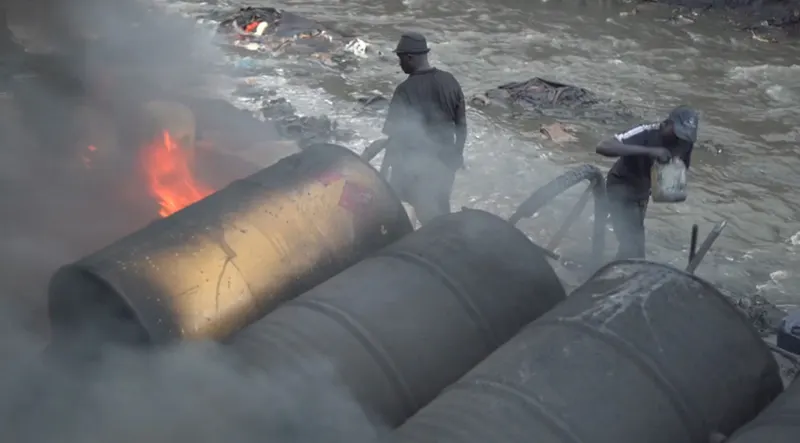
Chang'aa is a Kenyan home spirit. Crude cane sugar (jaggery), refined sugar or molasses is added to busaa beer or its dregs, or simply dissolved in water with baker's yeast, and fermented until it stops bubbling; the wash is then pot-distilled. The fermentation is microbial, but the spirit is a boundary entry because distillation makes the finished drink.
Amounts from a sourceThe rural and urban methods Nout recorded in 1979 during visits to 20 distillers. Rural households made 10–15 L of chang'aa every 2–4 weeks; urban distillers made 200–1000 L a week.
Strained busaa beer, or busaa dregs (rural method)
microorganisms from the busaa beer (rural); dehydrated baker's yeast (urban)
Total time across the recorded steps: 7 days
Start
Drag the bar or press Play
What changes:Crude cane sugar dissolves into the strained beer
Step 1 of 4
Strain busaa and add crude sugar
Time
Not documented
Temperature
Not documented
Salt
None given
Acidity
Not documented
Which microbes the steps name, step by step
Saccharomyces cerevisiae
Yeasts
Output: sugared beer (rural); or a 25 % (w/v) jaggery solution with baker's yeast (urban).
Flavour
Not documented
Texture
Not documented
Colour
Not documented
Microbes at work in this step
Not documented for this step.
Method
Measured measured in a studySet fixed by a specification or tested recipeReported one source reports itTypical a general value, not sourced for this fermentUnconfirmed not yet checked against a source
At a glance
Chang'aa is a Kenyan home spirit. Crude cane sugar (jaggery), refined sugar or molasses is added to busaa beer or its dregs, or simply dissolved in water with baker's yeast, and fermented until it stops bubbling; the wash is then pot-distilled. The fermentation is microbial, but the spirit is a boundary entry because distillation makes the finished drink. Made in 4 steps over 7 days. The longest step, ferment until gas stops (rural), takes 7 days (Nout M.J.R. 1979) and runs at 25–30 °C (Nout M.J.R. 1979). Saccharomyces cerevisiae does most of the fermenting.
Chang'aa is distilled, so it is a boundary entry; the ferment before the still is a sugar wash built on busaa beer or its dregs. Nout found that urban drum stills gave a better spirit than rural basin stills, and that the choice of raw material changed the fusel-alcohol content.
Kenyan standard
The Kenya standard for chang'aa gives 35–57 % vol; only 8 of 28 Kibera (Nairobi) samples met it in 2015
Yield
About 0.38 L of absolute alcohol per kg of black jaggery, averaged over 25 distillers
Nout rejected 24 of 33 commercial samples in 1979 for excess fusel alcohols, against quality standards adapted from Swiss spirit rules. A 2015 Nairobi study found methanol within the Kenyan limit in all samples but alcohol up to 85.8 % vol, and suspected that pure ethanol had been added. Those authors said the higher alcohols they measured had limited health significance, far below a guideline of 1000 g/hL of pure alcohol. They expected low methanol from this fermentation and blamed poisonings on solvent mixed into the drink. That is their view from one survey, and it clears no other batch. They also say cheap and illicit spirits have caused numerous outbreaks of alcohol poisoning, especially with methanol. In two Kenyan outbreaks studied, 21–29 % of the patients died, and symptoms usually start 12–24 hours after drinking. In the larger outbreak the toxic alcohol was found in sealed bottles as well as bootleg or homemade liquor. This page records what distillers did when Nout visited them, including adding ammonium nitrate to the wash. It is not a recipe. Do not distil spirits at home.
Nout recorded the belief that Nubian soldiers brought distilling to Kenya around the First World War, hence the name Nubian gin, while noting it may be older in western Kenya. The Chang'aa Prohibition Act, which a newspaper report of 21 August 1980 reprinted by Nout says came into force on 15 August, banned making and selling it. The Alcoholic Drinks Control Act of 2010 was passed to repeal the 1980 Act, and a 2010 news report says the new law requires chang'aa to be brewed in licensed facilities.