Side-by-side or overlay PDF diff driven by one engine that reads each file into a structured model — text, vector geometry, images, form fields, annotations — and compares the models. Moves show as moves, edits show only where they happened, and any PDF type works without picking a mode.
Open a STEP / STP part and it measures itself — volume, thinnest wall, draft and undercut checks on load, plus hole detection with a BOM. Measure, section, export STL. Rust + WASM B-rep kernel, runs in your browser.
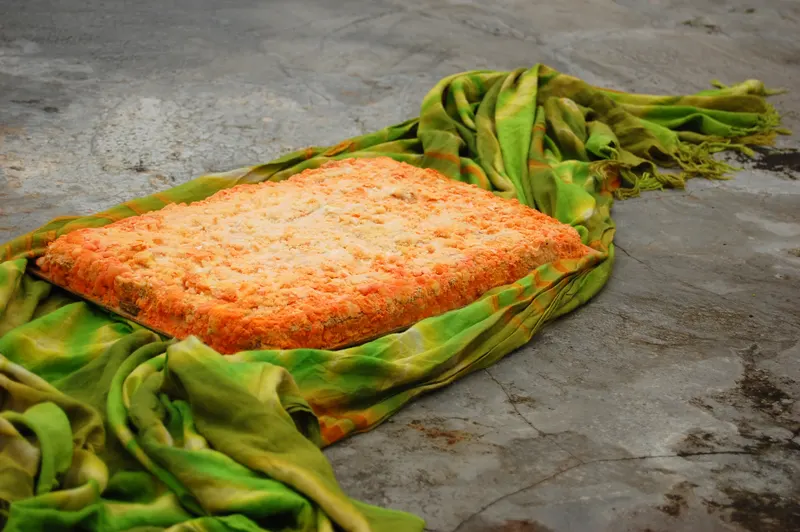
Oncom merah is a Sundanese food made by growing the orange mould Neurospora intermedia through cakes of food by-products, mainly okara, the soy pulp left from making soy milk and tofu. The steamed pulp is seeded from an earlier batch and in 36 to 48 hours becomes a firm block coated in orange spores, eaten as a meat substitute. It is the only traditional food known to be made by deliberately growing Neurospora.
No fixed amounts recordedTraditional producers use no fixed amounts. In a lab version, 12 mL of spore suspension was added to 300 g of steamed okara.
Okara (soy pulp)
The main by-product for the red type; the black type uses peanut press cake[rekdal2024]
Cassava pulp and peanut press cake
Also named as raw materials for oncom merah[syaputri2026]
Spores from an earlier batch of oncom
The traditional starter (backslopping)[rekdal2024]
Starter
backslop (spores from earlier oncom)
Total time across the recorded steps: 37 h – 2 days
Start
Drag the bar or press Play
What changes:Ground soybeans are drained and the solid soy pulp is kept
Step 1 of 4
Collect and drain the soy pulp
Time
Not documented
Temperature
Not documented
Salt
None given
Acidity
Not documented
Which microbes the steps name, step by step
Neurospora
Okara is the solid left when soaked, ground soybeans are pressed to make soy milk. In the lab version, soybeans soaked overnight at 4 °C were blended with three parts water and drained. Output: okara (soy pulp).
Flavour
Not documented
Texture
Not documented
Colour
Not documented
Microbes at work in this step
Not documented for this step.
Method
Measured measured in a studySet fixed by a specification or tested recipeReported one source reports itTypical a general value, not sourced for this fermentUnconfirmed not yet checked against a source
At a glance
Oncom merah is a Sundanese food made by growing the orange mould Neurospora intermedia through cakes of food by-products, mainly okara, the soy pulp left from making soy milk and tofu. The steamed pulp is seeded from an earlier batch and in 36 to 48 hours becomes a firm block coated in orange spores, eaten as a meat substitute. It is the only traditional food known to be made by deliberately growing Neurospora. Made in 4 steps over 37 h – 2 days. The longest step, let the orange mould grow through the cakes, takes 36 h – 2 days (Maini Rekdal V 2024) and runs at 29 °C (Maini Rekdal V 2024). Neurospora intermedia, the most abundant organism in all but one of 10 red oncom samples, at more than 50 % and up to more than 95 % of reads does most of the fermenting.
Unlike oncom hitam, which uses peanut press cake and is thought to rely on Rhizopus, red oncom grows Neurospora, mostly on soy pulp. Unlike tempeh, it is made from a by-product rather than whole beans.
Neurospora on other by-products (2024 study)Of 30 food by-products tested, the oncom fungus grew on all but grape pomace, olive pomace and buckwheat hulls; Danish tasters who had never eaten oncom liked fried fermented okara.
Safety
Clean production matters, because peanut press cake can carry moulds that make aflatoxin (Wikipedia), and a 2022 review reports aflatoxins in peanut and soybean press cakes such as oncom merah [owolabi2022]. The oncom strain of Neurospora intermedia has no known mycotoxin genes in its genome, but that says nothing about other microbes that get into a batch. Fermented soybean pulp has caused fatal bongkrekic acid poisoning in Central Java [han2023]. This bacterial toxin forms in warm, near-neutral ferments and is heat-stable, so cooking cannot be relied on. Food that holds it can look, smell and taste normal, and good sanitation lowers the risk but cannot rule it out [anwar2017].
Hazards the sources name: Burkholderia gladioli pathovar cocovenenans, which makes the toxin bongkrekic acid; fermented soybean pulp, this cake's main raw material, caused fatal poisoning in Central Java (not a study of oncom merah).
Neurospora intermedia is the main fungus in red oncom. Its oncom strains belong to a genetically distinct group found on human by-products such as sugar cane bagasse and corn cobs, which the 2024 study reads as a kind of domestication.