Side-by-side or overlay PDF diff driven by one engine that reads each file into a structured model — text, vector geometry, images, form fields, annotations — and compares the models. Moves show as moves, edits show only where they happened, and any PDF type works without picking a mode.
Open a STEP / STP part and it measures itself — volume, thinnest wall, draft and undercut checks on load, plus hole detection with a BOM. Measure, section, export STL. Rust + WASM B-rep kernel, runs in your browser.
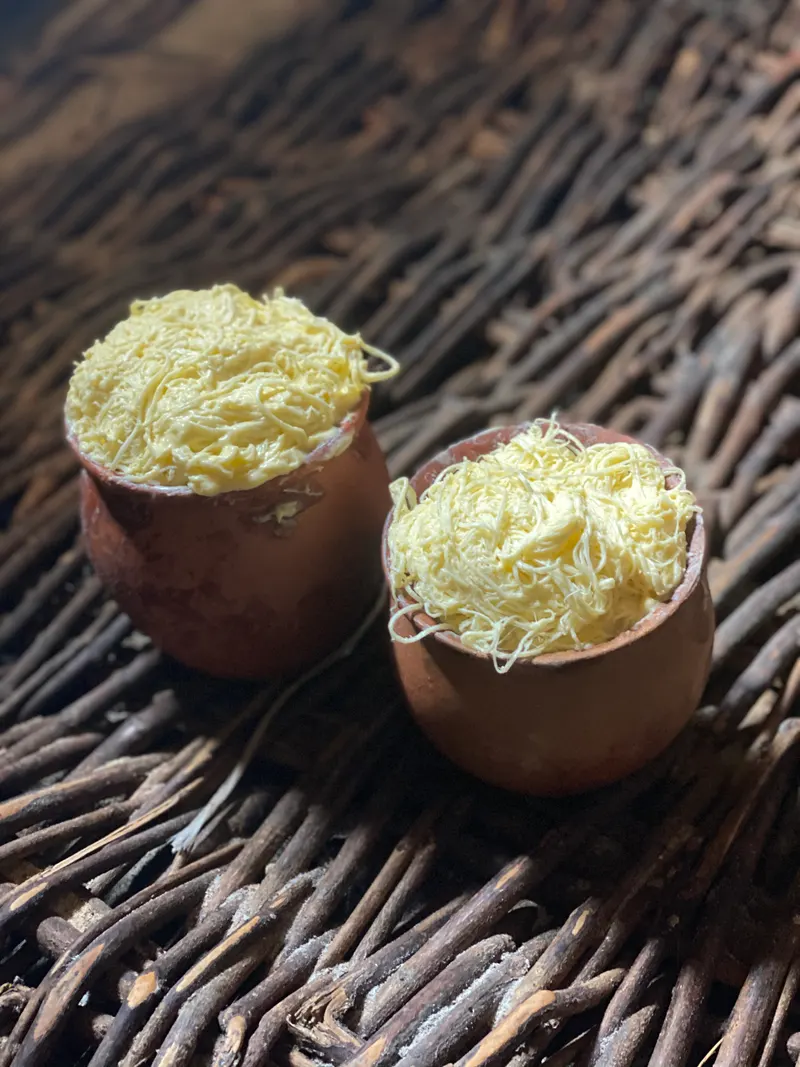
Cheese from Georgia, the Samtskhe-Javakheti region and a municipality of Kvemo Kartli
Teniliტენილი
Very fat sheep and cow milk is set with rennet in 30–40 minutes; the curd is cut small, heated to 37 °C, gathered and left in forms to get ready for stretching. It is then melted about 200 g at a time and stretched by hand again and again into fine threads, brined for 2–3 hours, rinsed in a cheese-fat decoction and packed tightly into ceramic pots. The pots are pressed, drained and stored on wood ash at 10–11 °C.
Total time across the recorded steps: 2.1 days – 3.2 days
Start
Drag the bar or press Play
What changes:Rennet sets the rich sheep and cow milk
Step 1 of 6
Set with rennet
Time
30–40 min
Set
Temperature
Not documented
Salt
None given
Acidity
Not documented
Flavour
Not documented
Texture
Not documented
Colour
Not documented
Microbes at work in this step
Not documented for this step.
Method
Measured measured in a studySet fixed by a specification or tested recipeReported one source reports itTypical a general value, not sourced for this fermentUnconfirmed not yet checked against a source
At a glance
Very fat sheep and cow milk is set with rennet in 30–40 minutes; the curd is cut small, heated to 37 °C, gathered and left in forms to get ready for stretching. It is then melted about 200 g at a time and stretched by hand again and again into fine threads, brined for 2–3 hours, rinsed in a cheese-fat decoction and packed tightly into ceramic pots. The pots are pressed, drained and stored on wood ash at 10–11 °C. Made in 6 steps over 2.1 days – 3.2 days. The longest step, drain and store on ash, takes 2–3 days (Ministry of Agriculture of Georgia 2012) and runs at 10–11 °C (Ministry of Agriculture of Georgia 2012).
Stretched by hand in small portions into very fine threads, rinsed in a cheese-fat decoction and pressed into ceramic pots, where it is kept cool on wood ash.
Composition
Moisture no more than 60 %; fat in dry matter no less than 45 %; salt 2–4 %
A 2023 study based on ethnographic literature and local accounts says tenili is now made in two ways, differing in milk fat, the liquid used for hand-working the curd and the ripening vessel. A second 2023 study describes a traditional process (skimmed milk, naturally acidified milk for coagulation and hot whey) and a non-traditional one (milk without skimming, home-made rennet, and cheese heads cut into hot water); both end with the same hand-stretching step.
Starter
The sources we found do not say how its fermentation begins.