Side-by-side or overlay PDF diff driven by one engine that reads each file into a structured model — text, vector geometry, images, form fields, annotations — and compares the models. Moves show as moves, edits show only where they happened, and any PDF type works without picking a mode.
Open a STEP / STP part and it measures itself — volume, thinnest wall, draft and undercut checks on load, plus hole detection with a BOM. Measure, section, export STL. Rust + WASM B-rep kernel, runs in your browser.
Cooked rice is covered with water and left overnight, for about 12 to 16 hours, so that lactic acid bacteria such as Weissella confusa sour it slightly. The pH falls only to about 5.4, so it is a mild, short ferment.
Both studies start from cooked rice. Output: cooked rice.
Flavour
Not documented
Texture
Not documented
Colour
Not documented
Microbes at work in this step
Not documented for this step.
Method
Measured measured in a studySet fixed by a specification or tested recipeReported one source reports itTypical a general value, not sourced for this fermentUnconfirmed not yet checked against a source
At a glance
Cooked rice is covered with water and left overnight, for about 12 to 16 hours, so that lactic acid bacteria such as Weissella confusa sour it slightly. The pH falls only to about 5.4, so it is a mild, short ferment. Made in 4 steps over 12 h – 16 h. The longest step, leave it overnight to sour, takes 12–16 h (Nath S 2021). Weissella confusa does most of the fermenting.
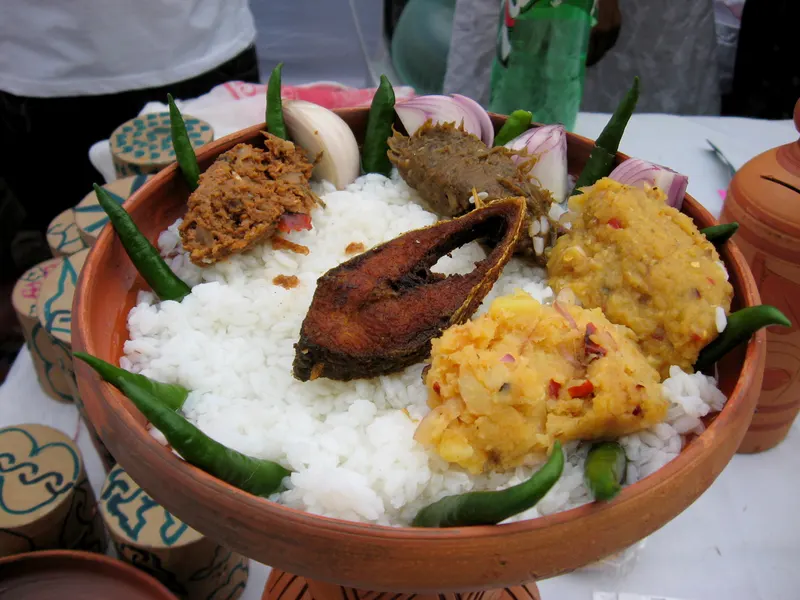
Poita bhat is a very short, mild ferment of rice that is already cooked, left one night under water. Panta bhat, eaten in Bangladesh and India, is made the same way, and Weissella confusa was found in both.
The rice is cooked before it is soaked. In one laboratory study of poita bhat the pH fell to about 5.4 in 12 h. In a study of panta bhat, the same kind of soaked cooked rice, from Bangladesh, the pH at 12 h was 5.81 at 20 °C and 4.86 at 30 °C. The FDA says Bacillus cereus grows from pH 4.9 to 9.3 and best at 28 to 35 °C, so the pH at 20 °C and in the laboratory study does not stop it. At 30 °C the pH was still 4.93 at 10 h, inside that range. The FDA says its vomiting toxin most often affects rice and other starchy foods, and that cooking may not disable the toxin. It advises keeping food at 40 °F (about 4 °C) or lower. The panta bhat study soaked the rice at 20 and 30 °C, well above that. No source we read tests this rice for B. cereus or gives a safe keeping time.
A traditional fermented rice of Assam. In 2016 Goswami and colleagues measured its pH, phytic acid and minerals over a 12 h fermentation. In 2021 Nath and colleagues sampled fermented sour rice from 23 households in Cachar district, Assam, and named Weissella confusa as the predominant fermenting bacterium.