Side-by-side or overlay PDF diff driven by one engine that reads each file into a structured model — text, vector geometry, images, form fields, annotations — and compares the models. Moves show as moves, edits show only where they happened, and any PDF type works without picking a mode.
Open a STEP / STP part and it measures itself — volume, thinnest wall, draft and undercut checks on load, plus hole detection with a BOM. Measure, section, export STL. Rust + WASM B-rep kernel, runs in your browser.
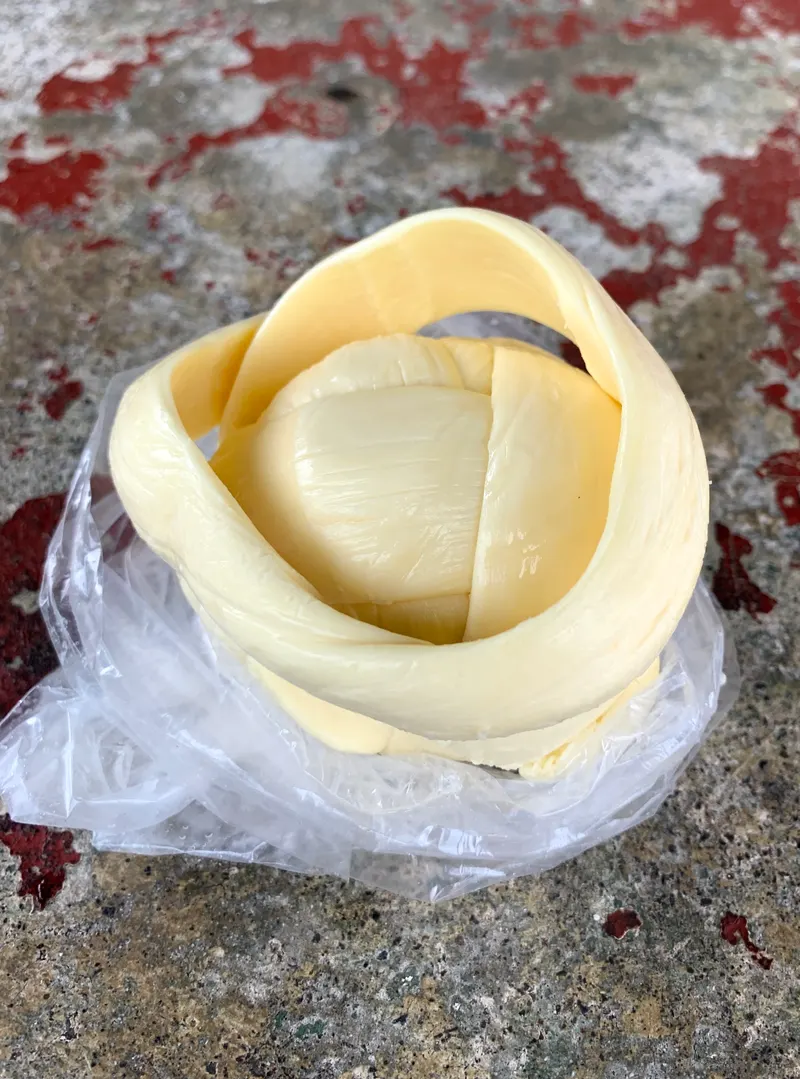
Costa Rica's rolled stretched-curd cheese, called arrollado as well as Palmito. In traditional dairies raw cow milk is set with rennet and soured with whey kept from the day before or by natural fermentation, and most artisan makers let the curd acidify for 4–5 hours. The curd is then cooked to about 72 °C, stretched by hand into strips, rolled up and brined; traditional cheeses are kept up to two weeks, industrial ones are mostly pasteurised and vacuum-packed.
Amounts from a sourceThe FAO description gives only the rennet dose (1/4 tablet per 20 L of milk). No source read here gives a batch size or amounts of whey or salt.
Whole cow milk, raw in traditional dairies
The FAO description says the milk gets no heat treatment; the 2015 study sampled pasteurised industrial cheeses too[fao1990][marin2023]
Whey kept from the previous day, as culture
Used by some traditional dairies; others rely on natural fermentation[fao1990][marin2023]
FAO gives a 6 hour brine; traditional cheeses taste saltier than refrigerated ones[fao1990][marin2023]
Starter
whey kept from the previous day (acid whey) in some traditional dairies, natural fermentation in others, a commercial culture in pasteurised industrial cheese
Total time across the recorded steps: 11 h – 12 h
Start
Drag the bar or press Play
What changes:Whole raw cow milk goes into the vat with no heat treatment
Step 1 of 7
Receive the raw milk
Time
Not documented
Temperature
Not documented
Salt
None given
Acidity
Not documented
Flavour
Not documented
Texture
Not documented
Colour
Not documented
Microbes at work in this step
Not documented for this step.
Method
Measured measured in a studySet fixed by a specification or tested recipeReported one source reports itTypical a general value, not sourced for this fermentUnconfirmed not yet checked against a source
At a glance
Costa Rica's rolled stretched-curd cheese, called arrollado as well as Palmito. In traditional dairies raw cow milk is set with rennet and soured with whey kept from the day before or by natural fermentation, and most artisan makers let the curd acidify for 4–5 hours. The curd is then cooked to about 72 °C, stretched by hand into strips, rolled up and brined; traditional cheeses are kept up to two weeks, industrial ones are mostly pasteurised and vacuum-packed. Made in 7 steps over 11 h – 12 h. The longest step, brine, takes 6 h (FAO 1990).
A Costa Rican pasta filata stretched into long strips and rolled up, which the FAO describes as a semi-hard unripened cheese with no rind. Many traditional makers use raw milk, whey from the day before and a long acidification.
Shape
Rolled up into an oval or round form
Types
Of 19 cheeses studied in 2015, unpasteurised with acid whey as culture, unpasteurised naturally fermented, and pasteurised with a commercial culture
In the traditional make the milk gets no heat treatment and the curd is cooked to 72° (FAO). Traditional cheeses are kept up to two weeks, mostly in chlorinated water at room temperature, and the paper notes that salting also acts as a preservative. That paper studied taste, so this is reported practice, not a tested safe keeping time. Industrial cheese is made from pasteurised milk, vacuum-packed and kept refrigerated for 20 to 40 days. A 2024 paper on artisanal and pilot-plant palmito found that the acidification and the kneading and stretching steps cannot replace milk pasteurisation and should not be the only safety steps, because its estimates never reached a 5-log reduction of all pathogens considered. ANSES advises pregnant women, young children, people over 65 and people with weak immunity not to eat raw-milk cheeses other than pressed cooked ones such as Gruyère, because of Listeria, Salmonella and Shiga-toxin E. coli.
Hazards the sources name: Listeria monocytogenes, Salmonella, Escherichia coli O157:H7 and Staphylococcus aureus; a 2024 paper on palmito cheese from three artisanal producers and a pilot plant estimated from the pH and water activity of the cheeses that all of them may support the growth of these four, and calculated that kneading and stretching heat cannot replace pasteurisation against Coxiella burnetii.
Wikipedia says it was first called queso arrollado ("rolled cheese") in Cutris, San Carlos, and later became known as queso palmito, a name that refers to heart of palm, which the cheese resembles. Wikipedia also records a 132 kg ball made by local cheesemakers at an expo in Zarcero in 2007.