Side-by-side or overlay PDF diff driven by one engine that reads each file into a structured model — text, vector geometry, images, form fields, annotations — and compares the models. Moves show as moves, edits show only where they happened, and any PDF type works without picking a mode.
Open a STEP / STP part and it measures itself — volume, thinnest wall, draft and undercut checks on load, plus hole detection with a BOM. Measure, section, export STL. Rust + WASM B-rep kernel, runs in your browser.
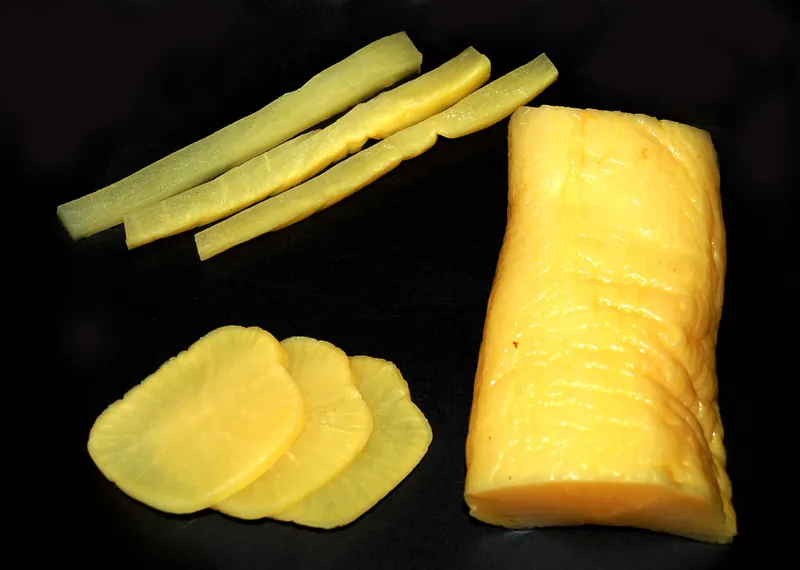
Takuan is daikon radish that is dried, either hung in sun and wind or pressed under salt, and then packed in salt and rice bran for months. Lactic acid bacteria sour it slowly while enzymes in the radish turn it yellow. Some makers add colour, such as safflower or turmeric, or use less salt.
No fixed amounts recordedThe MAFF Yamagata page gives a method for 50 daikon at 15–17 % salt. The 2020 study pickled 78 kg of air-dried daikon in 8 % NaCl. The sources give no household amounts.
15–17 % in the Yamagata method attributed to the monk Takuan; 8 % NaCl in the 2020 low-salt study[maff-yamagata][kobayashi2020]
Persimmon peel, eggplant leaves, chilli, kombu and turmeric
Ise makers sometimes add these as seasoning, and turmeric for colour; no amounts are given[maff-ise]
Total time across the recorded steps: 2.7 months – 13 months
Start
Drag the bar or press Play
What changes:Daikon hang in the sun and wind until they bend
Step 1 of 4
Hang daikon to dry (hoshi takuan)
Time
7–20 days
Reported
Temperature
Not documented
Salt
None given
Acidity
Not documented
Which microbes the steps name, step by step
Pediococcus pentosaceus
Output: dehydrated daikon.
Flavour
Not documented
Texture
daikon becomes flexible and bends without breaking
Colour
Not documented
Microbes at work in this step
Not documented for this step.
Method
Measured measured in a studySet fixed by a specification or tested recipeReported one source reports itTypical a general value, not sourced for this fermentUnconfirmed not yet checked against a source
At a glance
Takuan is daikon radish that is dried, either hung in sun and wind or pressed under salt, and then packed in salt and rice bran for months. Lactic acid bacteria sour it slowly while enzymes in the radish turn it yellow. Some makers add colour, such as safflower or turmeric, or use less salt. Made in 4 steps over 2.7 months – 13 months. The longest step, pack in bran and salt under weight, takes 2–12 months (MAFF にっぽん伝統食図鑑 2026) and runs at 4 °C (Kobayashi T. et al. 2020). Salt is 8 % (Kobayashi T. et al. 2020). Pediococcus pentosaceus does most of the fermenting.
Commercial takuanPre-pickled at low temperature and low salt, and coloured with yellow agents such as tartrazine and gardenia pigment, according to the 2020 study [kobayashi2020].
Iburi-gakkoAkita: daikon smoked 2–5 days over hardwood such as oak or cherry instead of sun-dried, then pickled in bran, salt and coarse sugar for 2 months or more (MAFF).
Safety
The Yamagata method relies on 15–17 % salt. MAFF says the pickle of that era was 3 to 5 times saltier than today's, and notes that milder, lower-salt takuan is now sold [maff-yamagata]. The 2020 study pickled at 8 % NaCl and 4 °C, and its authors expect acid to hold back microorganisms in such a low-salt pickle; the paper did not test this [kobayashi2020].
MAFF says accounts of takuan's origin differ, and that Kaminoyama (Yamagata) is held to be where the name began. The Zen monk Takuan Sōhō was sent to Kaminoyama in 1629 and stayed three years. The account says he turned a surplus of daikon, given by local people, into a preserved pickle and taught the method to them [maff-yamagata].
Starter
The sources we found do not say how its fermentation begins.