Side-by-side or overlay PDF diff driven by one engine that reads each file into a structured model — text, vector geometry, images, form fields, annotations — and compares the models. Moves show as moves, edits show only where they happened, and any PDF type works without picking a mode.
Open a STEP / STP part and it measures itself — volume, thinnest wall, draft and undercut checks on load, plus hole detection with a BOM. Measure, section, export STL. Rust + WASM B-rep kernel, runs in your browser.
Vegetables from Yamakawa district, Ibusuki, Kagoshima
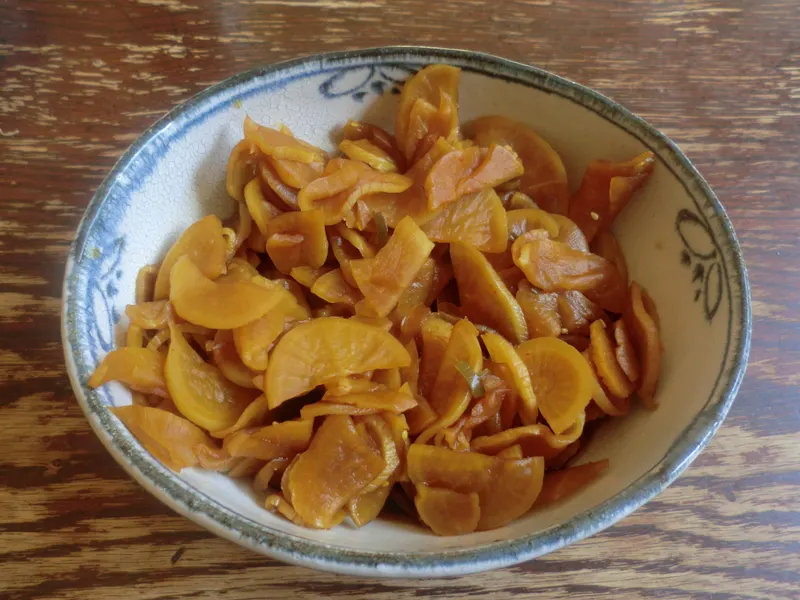
Yamakawa-zuke and tsubozuke (Kagoshima pounded dried-daikon pickle)山川漬
Yamakawa-zuke is a salt-only pickle of sun-dried daikon from Yamakawa in southern Kagoshima. The dried roots are pounded with salt in a wooden mortar so the salt gets in, then packed tight in large clay jars with no weight and fermented for half a year or more. Squeezing out as much water as possible is what lets it keep in the warm south.
Worked out as 5 % of the dried daikon weight[kumagai2025]
Total time across the recorded steps: 7 months – 13 months
Start
Drag the bar or press Play
What changes:Daikon dry in the winter sun on tall racks for about a month
Step 1 of 5
Sun-dry the daikon on racks
Time
30 days
Reported
Temperature
Not documented
Salt
None given
Acidity
Not documented
Which microbes the steps name, step by step
Pediococcus pentosaceus
Output: dried daikon.
Flavour
Not documented
Texture
Not documented
Colour
Not documented
Microbes at work in this step
Not documented for this step.
Method
Measured measured in a studySet fixed by a specification or tested recipeReported one source reports itTypical a general value, not sourced for this fermentUnconfirmed not yet checked against a source
At a glance
Yamakawa-zuke is a salt-only pickle of sun-dried daikon from Yamakawa in southern Kagoshima. The dried roots are pounded with salt in a wooden mortar so the salt gets in, then packed tight in large clay jars with no weight and fermented for half a year or more. Squeezing out as much water as possible is what lets it keep in the warm south. Made in 5 steps over 7 months – 13 months. The longest step, ferment and mature in the jar, draining the liquid, takes 6–12 months (熊谷奈々 2025). Salt is 5 % (熊谷奈々 2025). In homemade takuan, a related Japanese dried-daikon pickle (not yamakawa-zuke), one lactic acid bacterium, Pediococcus pentosaceus (strain TOKAI 10m), was isolated on MRS agar; the study did not survey the whole flora does most of the fermenting.
Most takuan is packed in rice bran under a weight. Yamakawa-zuke uses salt only, is pounded in a mortar, and is packed into clay jars with no weight; removing as much water as possible suits it to the warm south [ootomi2018]. Modern tsubozuke is a different, milder product [jawp-tsubozuke].
Tsubozuke (modern)When demand outgrew the jars, makers salted daikon in tanks, chopped it small and pickled it in soy sauce; it is mild and crunchy and sold nationwide [jawp-tsubozuke].
Safety
The sources credit its keeping to hard drying, about 5 % salt by dried weight and tight packing in a sealed jar [kumagai2025, ootomi2018], and they record no pH or water activity. An airless jar is not a safeguard. The bacteria that cause botulism live in soil and grow well with little oxygen (FDA), the CDC lists all fresh vegetables as low-acid foods, and it names improperly fermented homemade foods as a common source. A pathogen table in the FDA's seafood guide puts the growth limits for proteolytic Clostridium botulinum at pH 4.6 and water activity 0.935, and no source we read shows this pickle reaches either. You cannot see, smell or taste the toxin (CDC). This page records makers' large jars, not a safe home method.
Yamakawa-zuke was once called karazuke ("Chinese pickle"). In 1592, farmers near Yamakawa port supplied it as rations for Shimazu Yoshihisa's warships bound for Korea [ootomi2018]. The port had traded with Ming China since about 1474, and the method may have come with Chinese traders [kumagai2025]. The name Yamakawa-zuke dates from the Edo period [ootomi2018]. In 2018 only four shops still made it, and only two from raw daikon [ootomi2018].
Starter
The sources we found do not say how its fermentation begins.